
You’ve bought a Sony APS-C camera, or you’re about to. Now what about the lens? Is the kit lens fine? Should you go with a prime or a zoom? Does it have to be a Sony lens?
Still deciding on which camera body to buy? Before diving into lenses, make sure you have the right camera for your needs. Check out our Complete Sony Camera Lineup Guide to understand the big picture, or read our Sony a6000-Series Comparison (a6700 vs ZV-E10 II vs FX30) to find the perfect APS-C body for video and photo.
For anyone trying to choose their first lens for Sony APS-C, here’s how to base your decision and which ones are worth considering. By the end of this article, you’ll know exactly what to buy.
This guide is for anyone getting serious about photo and video and wants to start their lens collection off right.
Table of Contents
Sony, or a third-party brand?
Lenses generally fall into two categories: first-party lenses made by the camera manufacturer, and third-party lenses.
- Sony (native): Reassuring build quality, and top-tier AF speed and accuracy.
(Explore the official Sony E-mount Lens lineup here.) - Sigma / Tamron (the go-to third-party brands): Sometimes offer focal lengths or specs Sony doesn’t make natively
Comparing native and third-party options is the best way to find the lens that fits you.
Prime or zoom — which is better for your first lens for Sony APS-C?
Lenses come in two basic types, prime (fixed focal length) and zoom, but a zoom is the better choice for your first lens for Sony APS-C.
Some people say a 35mm prime is the ideal “one lens to own,” but for your first lens for Sony APS-C, something that covers from roughly 24mm equivalent (close to a smartphone’s field of view) up to the popular 35–50mm equivalent range is more practical.
Everyday snapshots Portraits Product photography Being able to freely choose your focal length depending on the room size or situation is exactly why a zoom makes more sense as your first lens for Sony APS-C.
Terms worth knowing before you buy
Here’s a quick rundown of the terminology you’ll run into while lens shopping.
What does “35mm equivalent” mean?
- The same focal length number produces a different field of view depending on sensor size
- So the industry uses “35mm (full-frame) equivalent” as a common reference
- Because an APS-C sensor captures a narrower field of view than full frame, you multiply the actual focal length by roughly 1.5x to get the “equivalent” number
- Example: 24mm on APS-C → equivalent to 36mm on full frame
- All focal lengths in this article are given in “equivalent” terms for consistency
What is the f-number (aperture)?
- The f-number indicates how much light a lens can let in
- The smaller the number, the brighter (faster) the lens; the larger the number, the darker (slower) it is
- Benefits of a bright lens (small f-number)
- Better performance in low light
- Easier to blur the background (“bokeh”)
- Brighter lenses tend to be bigger and heavier
- Reason: the glass elements themselves need to be larger to gather more light
- Reason: harder to design and manufacture
- Reason: more materials are needed
- Some zoom lenses change their f-number as you zoom
- “Constant aperture” lenses: the f-number stays the same throughout the zoom range (e.g. constant f/2.8, constant f/4)
- “Variable aperture” lenses: the f-number gets larger (darker) as you zoom in (e.g. f/3.5 → f/5.6)
- Most kit lenses are the variable-aperture type
- For video, constant-aperture lenses are easier to work with because the exposure stays stable
How zoom mechanisms work
- There are two ways a lens can zoom
- Manual zoom: you turn the zoom ring by hand. Often an “extending” design where the barrel physically gets longer
- Power zoom (motorized zoom): a button or lever triggers a motor that zooms automatically
- Advantages of power zoom
- Smooth, constant-speed zooming (great for video)
- Often paired with internal zoom (the lens barrel doesn’t change length as it zooms), which keeps things stable when mounted on a gimbal
- Zoom noise and visible movement
- Manual zoom: the barrel extends and retracts, so that motion can show up on camera during video
- Power zoom: a faint motor sound can sometimes be picked up by the mic
- Autofocus speed and quietness
- Most recent lenses are designed to be fast and quiet for video
- Sony’s own G and GM lenses in particular are known for fast, highly accurate AF
- Sigma and Tamron lenses are also plenty capable for video work
Can APS-C and full-frame lenses be used interchangeably?
- Normally, lenses aren’t interchangeable across different sensor sizes
- But Sony’s E-mount is an exception
- Both APS-C and full-frame E-mount lenses can be mounted on the same E-mount body
- Full-frame lens on an APS-C body: works, but the focal length becomes roughly 1.5x longer
- APS-C lens on a full-frame body: works, but the camera usually crops automatically, reducing resolution
- Because of this compatibility, if you’re planning to move to full frame down the line, you can choose to buy full-frame lenses now and carry them over later
Recommended lenses: Finding your ideal first lens for Sony APS-C
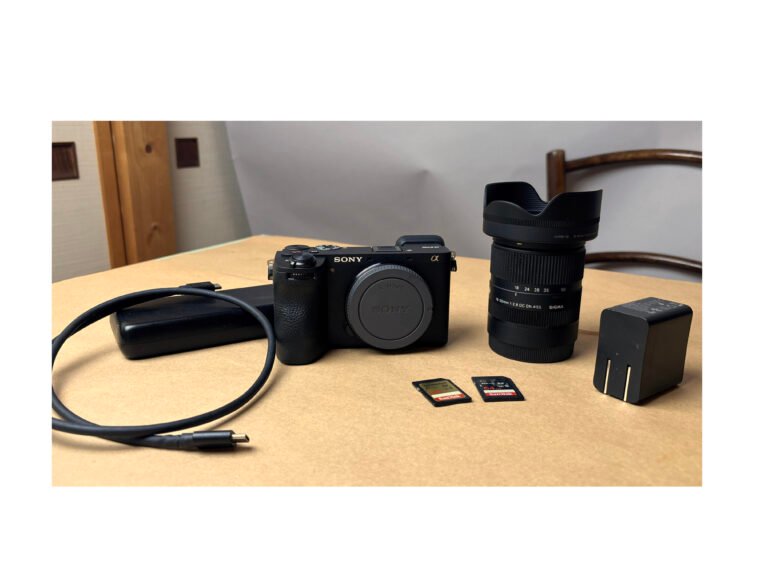
My personal pick for your first lens for Sony APS-C is the SIGMA 18-50mm F2.8 DC DN. It’s compact enough to rival a prime lens in weight while still offering constant f/2.8 brightness — meaning you can put more of your budget toward things like video lights and a mic.
Maximize your production value: Saving money on your first lens means you can invest in the gear that actually transforms your video quality—lighting and audio. Don’t miss our guide on the 15 Essential Accessories for the Sony a6700 to see exactly what you need to build a pro-level setup.
As a stellar option for your first lens for Sony APS-C, it offers the best value on this list. Below, every other lens is compared against this SIGMA as the baseline, along with who should consider going with something else instead.
SIGMA 18-50mm F2.8 DC DN [RECOMMENDED]

- SMALL AND LIGHT
- Versatile Focal range and ecellent optical Performace
- Superb Optical Quality
A best-value first lens that combines prime-lens-like weight with constant f/2.8 brightness. Its balance of compactness and image quality has earned it strong support among users.
- APS-C only / 290g
- Focal length: 18–50mm (27–75mm equivalent)
- Aperture: constant f/2.8
- Minimum focus distance: 0.121m (wide end) / 0.3m (tele end)
- Size: 65.4mm × 74.5mm / Filter thread: 55mm
Pros: light weight, constant f/2.8, compact size Cons: tele end tops out at 75mm equivalent, no in-lens image stabilization
👉 Check Price & Availability for SIGMA 18-50mm F2.8 DC DN
Standard zooms (everyday use, product shots, all-rounders)
TAMRON 17-70mm F/2.8 Di III-A VC RXD [POPULAR]

- World’s first high-speed standard zoom lens for APS-C cameras with the focal length range of 17-70mm 4.1x zoom ratio
- Outstanding optical performance with 16 elements in 12 groups featuring two GM (Glass Molded Aspherical) lens -elements …
- Upgraded VC effective in combination with Sony APS-C mirrorless cameras, leveraging AI for video shooting
An all-rounder for anyone who wants to shoot everything with a single lens, combining image stabilization with real reach. It’s a widely recognized staple among a6000-series users, often called a “must-have” lens.
- APS-C only / 525g
- Focal length: 17–70mm (25.5–105mm equivalent)
- Aperture: constant f/2.8
- Minimum focus distance: 0.19m (wide end) / 0.39m (tele end)
- Size: 74.6mm × 119.3mm / Filter thread: 67mm
Pros: in-lens image stabilization (VC), extended reach at the tele end (105mm equivalent) Cons: the heaviest and largest lens in this group
Compared to the SIGMA: has in-lens stabilization that the SIGMA lacks, making it more resistant to shake for both video and stills. Its tele end reaches 105mm equivalent, letting you get closer to distant subjects. However, at 525g it’s nearly double the SIGMA’s weight.
→ Best for: anyone who prioritizes image stabilization, wants a single lens that covers portraits and distant subjects, and doesn’t mind a bit more weight
👉 Check Price & Availability for TAMRON 17-70mm F/2.8 Di III-A VC RXD
SONY E PZ 18-105mm F4 G OSS

- High performance E mount lens with excellent contrast; Minimum Aperture (F): 22
- Minimum Focus Distance : 1.48 (Wide) 3.12 ft (Tele), Maximum Magnification ratio : 0.11x, Focal Length : 18 105 mm
- Versatile 27 158mm (35mm equiv.) zoom range. Angle of view (APS C): 76° 15°. Number of aperture blades are 7
A video-focused zoom built around a power-zoom mechanism for smooth handling during recording. Sometimes described as “the most versatile APS-C E-mount lens.”
- APS-C only / 427g
- Focal length: 18–105mm (27–157.5mm equivalent)
- Aperture: constant f/4
- Minimum focus distance: 0.45m (wide end) / 0.95m (tele end)
- Size: 78mm × 110mm / Filter thread: 72mm
Pros: power zoom + internal zoom, strong telephoto reach Cons: darker at f/4, minimum focus distance is long, so it’s not great for close-up shots
Compared to the SIGMA: its power zoom plus internal zoom design makes zooming during video very smooth, and its tele end reaches a substantial 157.5mm equivalent. However, at f/4 it’s darker than the SIGMA with weaker background blur, and its longer minimum focus distance makes close-up product shots harder.
→ Best for: video-first shooters who plan to use video lights, and anyone who wants more reach at the tele end
👉 Check Price & Availability for SONY E PZ 18-105mm F4 G OSS
SONY E 16-55mm F2.8 G [POPULAR]

- Standard zooms with outstanding corner-to-corner G lens resolution
- Constant F2.8 Max aperture maintains exposure and depth of field
- Two advanced aspherical plus two aspherical elements suppress aberration
The top-tier choice for anyone who wants Sony’s native G-series image quality and AF performance. Sometimes referred to as “effectively the best APS-C lens Sony makes.”
- APS-C only / 494g
- Focal length: 16–55mm (24–82.5mm equivalent)
- Aperture: constant f/2.8
- Minimum focus distance: 0.33m (throughout the zoom range)
- Size: 73mm × 100mm / Filter thread: 67mm
Pros: extremely fast, quiet AF, wide end starts at 24mm equivalent, weather-sealed Cons: no in-lens image stabilization
Compared to the SIGMA: benefits from Sony’s native G-series AF speed and quietness. Its wide end is wider than the SIGMA’s, at 24mm equivalent, and its weather sealing makes it more reliable outdoors. However, like the SIGMA, it has no in-lens stabilization.
→ Best for: anyone with room in their budget who wants to prioritize image quality and AF performance, shoots outdoors often and wants weather resistance, or cares about eye-AF accuracy on moving subjects
👉 Check Price & Availability for SONY E 16-55mm F2.8 G
Ultra-wide zooms (indoor selfies, vlogging, tight spaces)
SONY E PZ 10-20mm F4 G

- The world’s smallest, lightest ultra-wide-angle constant F4 APS-C power zoom lens combines outstanding mobility and imag…
- Internal zoom and focus allows for the lens to maintain its length when focusing or zooming, providing a stable center o…
- Expand your possibilities for visual expression with the power zoom system, making it easy to execute super-slow constan…
A world-class lightweight ultra-wide built for indoor selfies and vlogging in tight spaces. Reviewers have called its build quality “beyond question.”
- APS-C only / 178g
- Focal length: 10–20mm (15–30mm equivalent)
- Aperture: constant f/4
- Minimum focus distance: 0.2m (AF) / 0.13–0.17m (MF)
- Size: 69.8mm × 55.0mm / Filter thread: 62mm
Pros: one of the lightest lenses in its class, ultra-wide 15mm equivalent, power zoom + internal zoom Cons: darker at f/4, tele end tops out at 30mm equivalent, no in-lens image stabilization
Compared to the SIGMA: at 178g, it’s even lighter than the SIGMA. Its 15mm equivalent ultra-wide view helps make small rooms look more spacious on camera. However, at f/4 it’s darker than the SIGMA, and its tele end only reaches 30mm equivalent, which isn’t great for product shots or portraits.
→ Best for: anyone whose main use case is indoor selfies, vlogging, or room tours in a small space
👉 Check Price & Availability for SONY E PZ 10-20mm F4 G
TAMRON 11-20mm F/2.8 Di III-A RXD [POPULAR]

- F2.8 ultra wide-angle zoom lens for APS-C mirrorless cameras
- Compact and lightweight for superior usability (3.4″ long and 11.8 oz.)
- Close focusing capability with MOD of 5.9″ at 11mm and 9.4″ at 20mm with 1:4 Max. Mag. Ratio at 11mm
An ultra-wide with constant f/2.8 brightness, built for people who care about creative expression. Known for its compact size and strong AF performance.
- APS-C only / 335g
- Focal length: 11–20mm (16.5–30mm equivalent)
- Aperture: constant f/2.8
- Minimum focus distance: 0.15m (macro-level performance at the wide end)
Pros: bright f/2.8 aperture at ultra-wide focal lengths, gets as close as 0.15m Cons: tele end tops out at 30mm equivalent, manual zoom only, no in-lens image stabilization
Compared to the SIGMA: its ultra-wide 16.5mm equivalent start and minimum focus distance of 0.15m allow for creative wide-macro shots. However, its tele end only reaches 30mm equivalent, narrower than the SIGMA’s range for everyday and product shots, and at 335g it’s a bit heavier.
→ Best for: anyone who values creative expression and background blur at ultra-wide focal lengths, and shoots mostly indoors rather than everyday snapshots
👉 Check Price & Availability for TAMRON 11-20mm F/2.8 Di III-A RXD
High-end, full-frame-compatible options (a minimalist choice with an eye on the future)
SONY FE 16-35mm F4 G

- Ultralight, versatile wide-angle power zoom. Sony’s vast expertise brings you the world’s lightest1 full frame F4 wide-a…
- Smooth power zoom with rapid response. A new power zoom system driven by four XD (Extreme Dynamic) Linear Motors for the…
- Designed for refined movie imagery. In addition to smooth, versatile power zoom, this remarkably compact lens minimizes …
A full-frame lens that happens to land at an ideal focal range on APS-C — a minimalist pick for anyone thinking ahead. Praised for “consistently strong performance across the entire zoom range.”
- Full-frame compatible (also works on APS-C) / 353g
- Focal length: 16–35mm (24–52.5mm equivalent when mounted on APS-C)
- Aperture: constant f/4
- Minimum focus distance: 0.28m (wide end) / 0.24m (tele end)
- Size: 80.5mm × 88.1mm / Filter thread: 72mm
Pros: an ideal 24–52.5mm equivalent range on APS-C, lightweight, keeps working if you move to full frame later Cons: darker at f/4, no in-lens image stabilization
Compared to the SIGMA: if you upgrade to full frame down the line, this lens keeps working exactly as intended. At 353g it’s light, and its wide end reaches 24mm equivalent. However, its tele end only goes to 52.5mm equivalent, narrower than the SIGMA’s for close-up product work.
→ Best for: anyone planning to move to full frame eventually and who doesn’t want to rebuy lenses
👉 Check Price & Availability for SONY FE 16-35mm F4 G
SONY FE 16-35mm F2.8 GM II

- The world’s smallest, lightest1 full-frame F2.8 wide-angle zoom
- Breathtaking G MasterTM image quality right out to the edges of the frame
- Extraordinary resolution and bokeh throughout the zoom range
A no-compromise, professional-grade lens. Often described as “currently one of the best options available.”
- Full-frame compatible (also works on APS-C) / 547g
- Focal length: 16–35mm (24–52.5mm equivalent when mounted on APS-C)
- Aperture: constant f/2.8
- Minimum focus distance: 0.22m (throughout the zoom range)
Pros: top-tier resolution and f/2.8 brightness, gets as close as 0.22m Cons: the heaviest lens on this list, manual zoom only
Compared to the SIGMA: as Sony’s flagship “G Master” lens, it offers top-tier f/2.8 brightness and edge-to-edge resolution. However, at 547g it’s considerably heavier.
→ Best for: anyone who refuses to compromise on image quality and wants a professional-grade lens that carries over to full frame
👉 Check Price & Availability for SONY FE 16-35mm F2.8 GM II
Bottom line: which first lens for Sony APS-C should you actually get?
For your first lens for Sony APS-C, my personal pick is the SIGMA 18-50mm F2.8, thanks to its excellent balance of weight, brightness, and compactness. If you’re not sure, this is the safest choice for your first lens for Sony APS-C. From there, consider the other options based on what matters most to you.
Standard zooms (everyday use, product shots, all-rounders)
- SIGMA 18-50mm F2.8 DC DN [RECOMMENDED] (baseline) | 27–75mm equivalent → Best if you want the best balance of weight and brightness, above all else
- TAMRON 17-70mm F/2.8 VC RXD [POPULAR]
25.5–105mm equivalent → Best if you want image stabilization, or a single lens that covers distant subjects too - SONY E PZ 18-105mm F4 G OSS
27–157.5mm equivalent → Best if you’re video-focused and plan to use video lights, or want more telephoto reach - SONY E 16-55mm F2.8 G [POPULAR]
24–82.5mm equivalent → Best if you want top-tier image quality and AF, or shoot outdoors a lot
Ultra-wide zooms (indoor selfies, vlogging, tight spaces)
- SONY E PZ 10-20mm F4 G
15–30mm equivalent → Best if your main use case is indoor selfies, vlogging, or room tours in a small space - TAMRON 11-20mm F/2.8 RXD [POPULAR]
16.5–30mm equivalent → Best if you value creative expression and background blur at ultra-wide focal lengths
High-end, full-frame-compatible options (a minimalist choice with an eye on the future)
- SONY FE 16-35mm F4 G
24–52.5mm equivalent (mounted on APS-C) → Best if you’re planning to move to full frame and don’t want to rebuy lenses - SONY FE 16-35mm F2.8 GM II
24–52.5mm equivalent (mounted on APS-C) → Best if you refuse to compromise on image quality
Quick guide: if you can only pick one
- Just want to start light → SIGMA 18-50mm F2.8
- Image stabilization is non-negotiable → TAMRON 17-70mm F2.8
- You care most about smooth video zoom → SONY 18-105mm F4 G
- You won’t compromise on image quality or AF → SONY 16-55mm F2.8 G
- Indoor selfies/vlogging is your main use case → SONY 10-20mm F4 G
- You want ultra-wide with background blur too → TAMRON 11-20mm F2.8
- You’re planning to move to full frame someday → SONY FE 16-35mm F4 G (or the F2.8 GM II if you want the pro-grade option)
What’s Next? Gear Up Your Camera
Once you’ve chosen your first lens, you’ll need the right SD cards, microphones, and lighting to get the most out of your Sony APS-C camera. Check out our comprehensive guide on the Essential Accessories for the Sony a6700 to complete your creative setup.
Disclosure: This article uses affiliate programs, including the Amazon Associates Program. If you make a purchase through one of these links, I may earn a commission